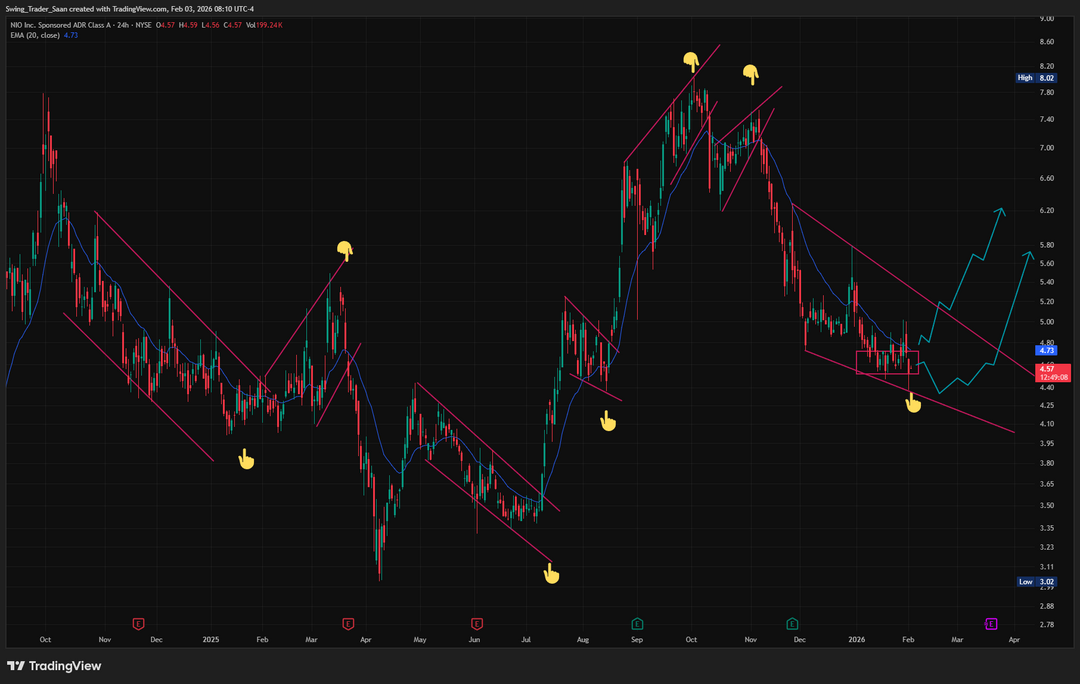
While it may not look like it at first glance, bear channels and bear wedges often function the same way as bull flags. Statistically, they resolve higher roughly 70% of the time — and vice versa in downtrends.
As always, I encourage you to study this yourself. Doing that work builds real confidence. Like always in trading — marking these patterns in hindsight is far easier than identifying and trading them in real time. With enough practice — and most importantly, solid risk management — these structures will become (very) profitable over time when executed correctly.
I know traders who prefer a higher-probability approach and choose to scale into positions at these levels. They start small and add as price moves lower. Their win rate might be closer to 60%, but in most cases the average profit per trade is smaller.
This style also comes with a real danger. Roughly 30% of the time the pattern fails, and by then the trader may already be in three times their initial size. Because the position has grown larger than normal, it becomes very easy to make emotional decisions. That’s exactly when you need to be razor-sharp. When these patterns fail, they often fail fast, as traders and algorithms exit simultaneously. Precision matters — you need to act like a sniper, not hesitate.
I know many traders who operate this way, and it’s a perfectly valid approach.
Personally, I prefer a different style. I trade with tight stops, so that if the move starts immediately, I’m already in with a larger position. The downside is that my win rate is lower — often around 40% — because I may need a few attempts before catching the winner.
The upside is that the reward is usually three times the risk or more. With that kind of expectancy, over a large sample size — say 200 trades — the outcome is almost always a meaningful profit, provided execution and discipline are consistent.
Both styles have clear pros and cons. Over the long run, their results tend to converge. No approach is inherently superior. It ultimately comes down to personal preference, psychology, and execution.
What matters most isn’t the pattern itself — it’s how you manage risk and stay consistent.
For educational purposes only— not financial advice.
Want this kind of breakdown on every trade?
Inside Patreon, every position — wins and losses — gets the full plan-execute-manage-review treatment. Daily updates while trades are on. Direct chat with me.
Join on PatreonEducational content only. Trading involves substantial risk. The setup grade and outcome described here are specific to my plan, sizing, and risk tolerance. Do your own work.
Leave a Reply